How to Choose the Right Metal Mesh for Your Project?
Choosing the right metal mesh begins with understanding the project’s actual demands. Appearance matters, but performance decides whether the installation succeeds.
Metal mesh specialist Geoff Wicks once said, “The right mesh begins with the load, not the look.” This practical view remains valuable. A decorative stainless steel mesh may suit an interior screen, yet fail in a coastal façade without proper corrosion resistance. Check the environment, expected loads, temperature, cleaning methods, and contact with other metals. Small details matter.
Start with the opening size. Smaller apertures improve screening and protection, while larger openings can increase airflow and visibility. Wire diameter affects strength, weight, flexibility, and cost. Material selection matters too. Stainless steel, galvanized steel, aluminum, and copper each behave differently in service. Ask for technical data, tolerances, surface treatment details, and sample pieces before approving production.
Measure twice.
Real projects are rarely perfectly predictable. I have seen mesh selected from a catalogue, only to reveal awkward fixing points during installation. That mistake is avoidable, but not always obvious at the design stage. Review the frame, edge finish, tensioning method, and maintenance access with the fabricator. A mesh that looks ideal on paper may perform poorly when cut, bent, or exposed to weather. This guide explores those choices carefully, including the compromises that designers sometimes overlook.
Define Your Project’s Functional and Environmental Requirements
How to Choose the Right Metal Mesh for Your Project?
Define your project’s functional and environmental requirements before comparing mesh materials. Identify the mesh’s job: filtration, guarding, ventilation, screening, or structural support. Then record the required opening size, wire diameter, panel dimensions, and expected load. A two-millimeter opening may protect sensitive equipment, but it can restrict airflow more than expected.
Environmental conditions often determine the material choice. Outdoor installations may face rain, salt, dust, ultraviolet exposure, or frequent temperature changes. Processing areas may require resistance to cleaning chemicals and repeated washing. Check operating and peak temperatures, not only the normal range. In field inspections, corrosion frequently begins around cut edges, welds, and poorly sealed joints. These details are easy to miss.
Tips:
Create a simple requirement sheet before requesting quotations. Include airflow, particle size, impact risk, cleaning methods, and maintenance access. Ask for material certificates, aperture tolerances, load data, and corrosion information. Confirm whether testing reflects your real environment. A supplier’s general claim may not represent your conditions. I have sometimes over-specified mesh for safety, increasing cost without improving performance. That is worth reconsidering. Conversely, choosing a lighter mesh can create vibration, deformation, or early replacement. Review a sample under realistic conditions, such as dust exposure, water spray, or repeated handling. Small trials reveal problems that drawings cannot.
Compare Metal Mesh Materials, Alloys, and Surface Treatments
How to Choose the Right Metal Mesh for Your Project?
Metal choice should follow the working environment, not appearance alone. Stainless steel mesh offers strong corrosion resistance and stable performance near moisture. The International Stainless Steel Forum reported global stainless steel production at about 60 million tonnes in 2023. This scale reflects its broad industrial use, but stainless grades still differ greatly. Grade 304 suits general indoor and outdoor applications. Grade 316 performs better near saltwater because of its molybdenum content. Carbon steel mesh costs less and provides high strength, yet it needs reliable protection. Aluminum mesh is lightweight and naturally forms a protective oxide layer. The International Aluminium Institute notes that recycled aluminum uses roughly 5% of the energy required for primary production.
Surface treatment can change service life significantly. Hot-dip galvanizing creates a zinc barrier and sacrificial protection for carbon steel. Powder coating adds color and improves resistance to weathering, but damaged edges may expose the base metal. Stainless steel passivation removes surface contamination and supports corrosion resistance. Electropolishing can produce a smoother, cleaner surface for hygienic equipment. However, no treatment is perfect. I have seen mesh fail because cut edges were ignored.
Tips: Match the alloy to the exposure, load, and cleaning chemicals. Check aperture size after coating. Ask for coating thickness, adhesion, and corrosion-test data. Salt-spray results help comparison, but ISO 9227 testing does not fully predict outdoor service life. Consider galvanic corrosion when dissimilar metals touch. A small trial panel can reveal problems before full installation.
How to Choose the Right Metal Mesh for Your Project?
Compare representative tensile strength values for common mesh materials and alloys. Actual performance varies with wire diameter, temper, weave, heat treatment, and product standard.
Surface Treatment Guide
Passivation
Common for 304 and 316 stainless steel. It removes free iron from the surface and improves corrosion resistance without adding a coating layer.
Galvanizing
A zinc coating provides barrier protection and sacrificial corrosion protection for carbon steel mesh. Performance depends on coating mass and environment.
Anodizing
Used mainly for aluminum alloys. It creates a durable aluminum-oxide layer that improves surface hardness and corrosion resistance.
Powder Coating
A polymer coating adds color and barrier protection to steel or aluminum mesh. Scratches and cut edges should be repaired to limit corrosion.
The tensile-strength figures are representative values in MPa for commonly specified alloy conditions, including 5052-H32 aluminum, annealed 304 and 316 stainless steel, galvanized low-carbon steel, Grade 2 titanium, and half-hard C11000 copper. Verify the supplier’s mill certificate and applicable ASTM, EN, or ISO specification before final selection.
Select the Right Mesh Pattern, Opening, and Wire Dimensions
Choosing metal mesh starts with the opening, not the catalog image. A sieve analysis from ASTM E11-24 shows why: aperture sizes are measured precisely in micrometres and millimetres. A 1.0 mm opening can pass fine granules, while a 5.0 mm opening may allow unwanted fragments through. Define the target particle size first. Then include a tolerance range, because real materials are rarely uniform.
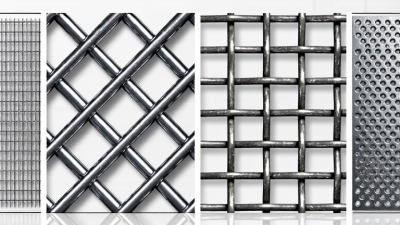
Pattern controls strength, flow, and cleaning. Plain weave suits general screening and moderate loads. Twill weave can provide smaller openings with stronger support. For high airflow, a perforated or expanded pattern may work better than tightly woven wire. A 2024 market assessment by Grand View Research reported continued growth in metal mesh demand, driven by filtration, construction, and industrial processing. That growth does not make every mesh suitable. Application details still matter.
Wire diameter deserves equal attention. Thicker wire improves impact resistance but reduces open area. Thinner wire increases flow but may deform under vibration. I once selected an opening correctly but underestimated wire fatigue near a vibrating feed point. The screen failed earlier than expected. That mistake changed my process: check load, temperature, corrosion, cleaning method, and support spacing before approval. ISO 3310-1 also emphasizes controlled aperture dimensions for test sieves. Ask suppliers for material certificates, aperture tolerances, and inspection results. Small details matter. A practical trial remains valuable, especially when dust, moisture, or irregular particles affect performance.
How to Choose the Right Metal Mesh for Your Project? - Select the Right Mesh Pattern, Opening, and Wire Dimensions
| Mesh Pattern |
Typical Opening Shape |
Common Opening Range |
Typical Wire Diameter |
Approx. Open Area |
Recommended Applications |
Selection Considerations |
| Plain Woven |
Square |
20 µm–6 mm |
20 µm–1.6 mm |
Approximately 25%–79% |
Fine filtration, laboratory screens, dust control, and general separation |
Provides uniform openings and accurate particle separation; finer mesh usually requires careful handling. |
| Twill Woven |
Square |
20 µm–3 mm |
25 µm–1.2 mm |
Approximately 20%–65% |
Pressure filtration, demanding screening, and applications requiring greater fabric strength |
The interlaced structure supports higher wire counts and pressure than many plain-weave designs. |
| Dutch Woven |
Rectangular or layered openings |
5–300 µm |
25 µm–0.5 mm |
Approximately 15%–45% |
High-pressure liquid filtration, polymer filtration, and fine process filtration |
Offers strong retention and high mechanical stability, but normally has lower flow area. |
| Perforated Sheet |
Round, square, slotted, or rectangular |
0.5–150 mm |
Sheet thickness: 0.5–12 mm |
Approximately 20%–60% |
Guards, screens, acoustic panels, walkways, and architectural cladding |
Choose hole shape, pitch, sheet thickness, and edge margin according to strength and airflow needs. |
| Expanded Metal |
Diamond or hexagonal |
Short-way opening: 2–75 mm |
Sheet thickness: 0.5–6 mm |
Approximately 30%–80% |
Platforms, machine guards, ventilation covers, walkways, and lightweight barriers |
Provides good strength-to-weight performance; account for strand width and opening direction. |
| Welded Wire Mesh |
Square or rectangular |
6–200 mm |
1.0–12 mm |
Approximately 35%–90% |
Cages, partitions, reinforcement, safety barriers, and material storage |
Rigid welded intersections simplify fabrication; verify weld quality for vibration or impact loads. |
| Crimped Woven Mesh |
Square or rectangular |
1–100 mm |
0.5–12 mm |
Approximately 35%–75% |
Quarry screens, vibrating screens, aggregate separation, and heavy-duty guards |
Suitable for larger openings and impact loads; select crimp style to improve dimensional stability. |
Practical Selection Guide:
Start with the required particle size or clear opening, then confirm the necessary open area, wire or sheet thickness, load capacity, operating temperature, corrosion exposure, and cleaning method. The listed ranges are typical engineering values; final specifications should be verified against the selected material, manufacturing tolerance, and service conditions.
Evaluate Strength, Filtration, Airflow, and Visibility Needs
How to Choose the Right Metal Mesh for Your Project?
Choosing metal mesh starts with the working conditions, not appearance. Strength depends on wire diameter, opening size, material, and support spacing. A fine mesh may filter particles well, but it can deform under pressure or vibration. For guards, screens, and walkways, check the expected load and fixing method. I have seen installations fail because the mesh was strong enough, but the frame was not.
Filtration requires more than selecting a stated micron size. Measure the particle range, flow rate, temperature, and pressure drop. Smaller openings improve filtration, yet they can restrict airflow and collect debris faster. Cleanability also matters. A dusty intake may need a slightly larger opening than laboratory testing suggests. Test the mesh under real operating conditions when possible. It is easy to overestimate performance.
Tips: Compare open area before ordering. Hold a sample against the light. Ask for test data, coating details, and tolerances. Check corrosion exposure, especially near moisture or chemicals. Visibility creates another trade-off. Tighter mesh hides equipment and improves protection, while larger openings provide clearer sight and stronger airflow. Leave room for maintenance access. That detail is often missed. A practical choice balances protection, pressure loss, visibility, and service life rather than chasing one perfect specification.
Verify Standards, Installation Methods, Costs, and Maintenance Requirements
Choosing metal mesh starts with verifying the required standard, not the lowest quotation. ISO 4783-1 defines technical requirements for industrial wire screens, while ASTM A580/A580M covers stainless steel wire products. Check wire diameter, opening size, tolerance, grade, and test documentation. A certificate without traceable batch information is weak evidence. Ask for it anyway.
Installation changes performance. Woven mesh may need tensioning, edge reinforcement, and carefully spaced fasteners. Welded mesh usually installs faster, but cut edges can expose vulnerable steel. For guards, platforms, or screens, confirm loads, clearances, and local safety requirements before fabrication. A small measurement error can create a large site problem. Keep a sample panel for checking fit and finish.
Cost comparison should include labor, coating, transport, replacement, and inspection. The NACE IMPACT study estimated global corrosion costs at about 3.4% of worldwide GDP, showing why material protection deserves serious attention. Hot-dip galvanizing, stainless steel, or a protective coating may cost more initially. Their value depends on moisture, salt, chemicals, and cleaning access. The U.S. Department of Energy also promotes life-cycle costing for industrial improvements, rather than purchase-price decisions alone.
Maintenance is often underestimated. Inspect loose fasteners, broken welds, blocked openings, rust staining, and coating damage. Record findings with dated photographs. Rinse salt deposits before they become persistent corrosion cells. This sounds simple. It is often missed. A practical maintenance schedule should reflect the environment, not an attractive promise from a supplier.